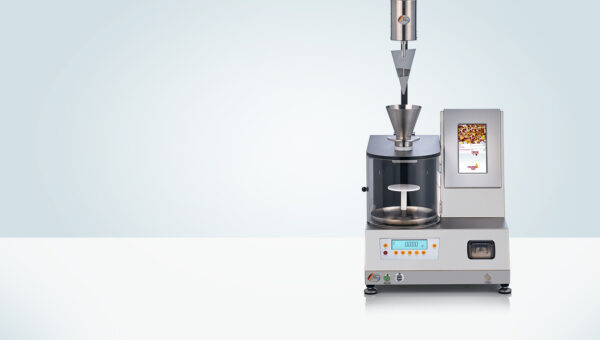
PT-TD430
Tapped Density and Apparent Density Tester
PT-TD430
Tapped Density and Apparent Density Tester
PT-TD430 is used to test the tapped (or “tamped”) density and apparent density of powders, granules, pigments and similar products in compliance with the current USP <616> methods 1 and methods 2 as well as with EP <2.9.34>, DIN EN ISO 787-11, ASTM B527 and ASTM D7481.18. The instrument automatically calculates the tapped density, Hausner flowability ratio and Carr compressibility index after each test and documents the results via the integrated protocol printer.
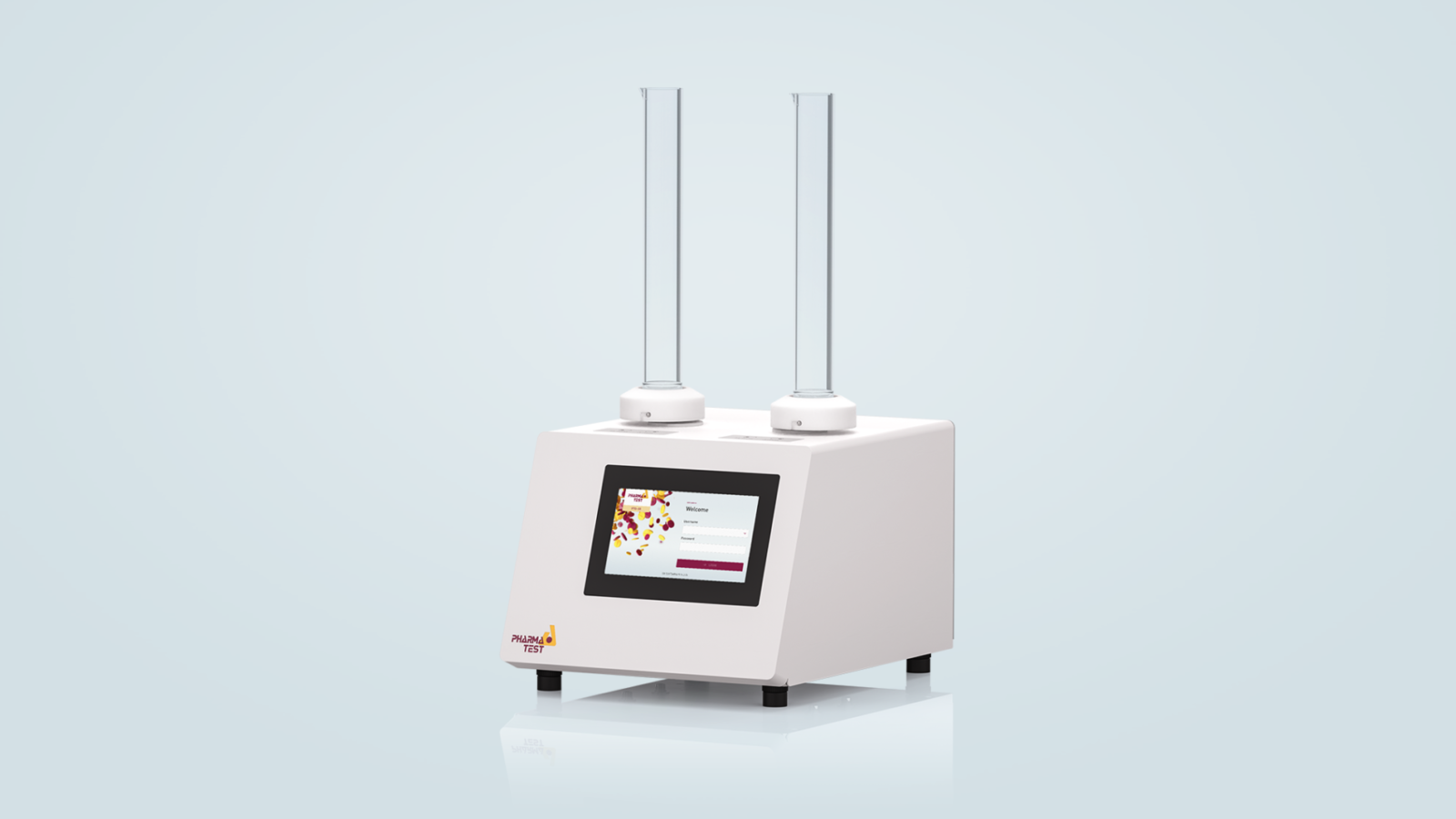
The bulk density of powders is usually reported both as “freely settled” and “tapped”. The tapped density refers to the bulk density of the powder after a specified compaction process, usually involving tapping motion of the product cylinder. The instrument can be used to derive additional physical product characteristics such as flowability and compressibility. Together these behavioural characteristics are used to maintain and improve product quality during development as well as securing product consistency in quality assurance and in-process control. The standard test cylinder volume is 250ml. Sets to test smaller volumes of 100, 50, 25 and 10ml are available as well.
As per USP <616> the sample is initially tapped 10, 500, and 1250 times (strokes). The volume of the tapped sample is checked and another 1250 tap test follows. This procedure is repeated in case the volumes at 500 taps (V2) and 1250 taps (V3) differ by more than 2ml. This result is used to calculate the tapped density. The ability of the powder to settle is calculated as the difference between V1 and V2. Tapped density is expressed in g/ml and calculated as weight divided by volume. Furthermore the instrument automatically calculates the Hausner flowability ratio and Carr compressibility index. The Hausner ratio is used in a wide variety of industries as an indication of the flowability of a powder. It is related to the Carr index, which is an indication of the compressibility of a powder. According to these indices the results are evaluated (excellent > good > fair > passable > poor > very poor > very, very poor).
User Interface
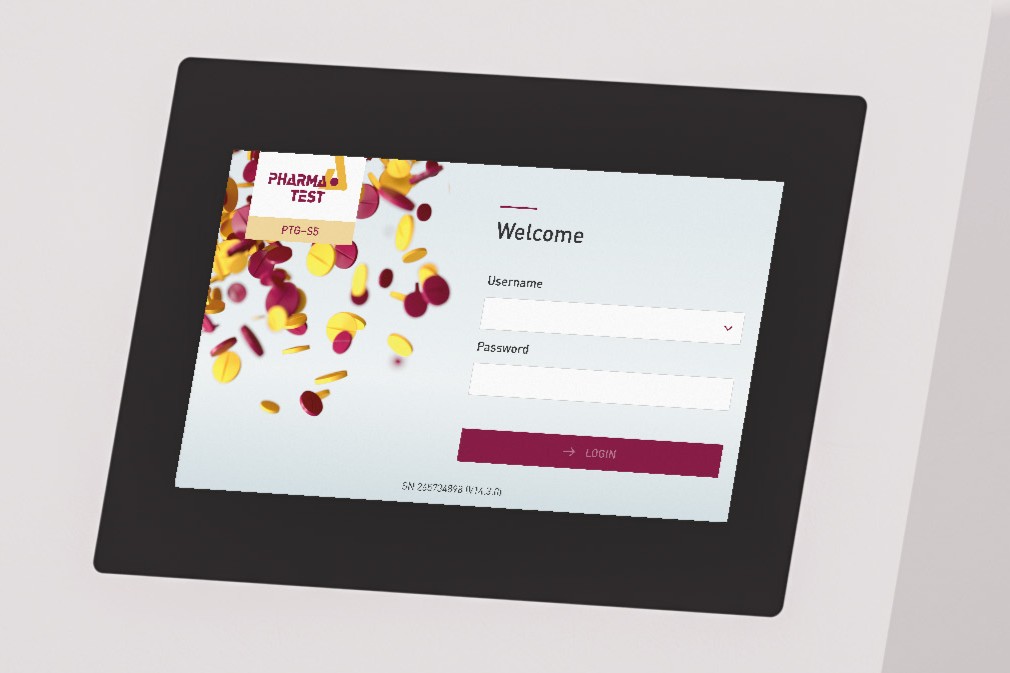
PT-TD430 features a large, 7” backlit color touch screen with a state-of-the-art graphic user interface (GUI).
Instrument Design
The instrument body is made from high quality powder coated stainless steel which fully meets GLP requirements.
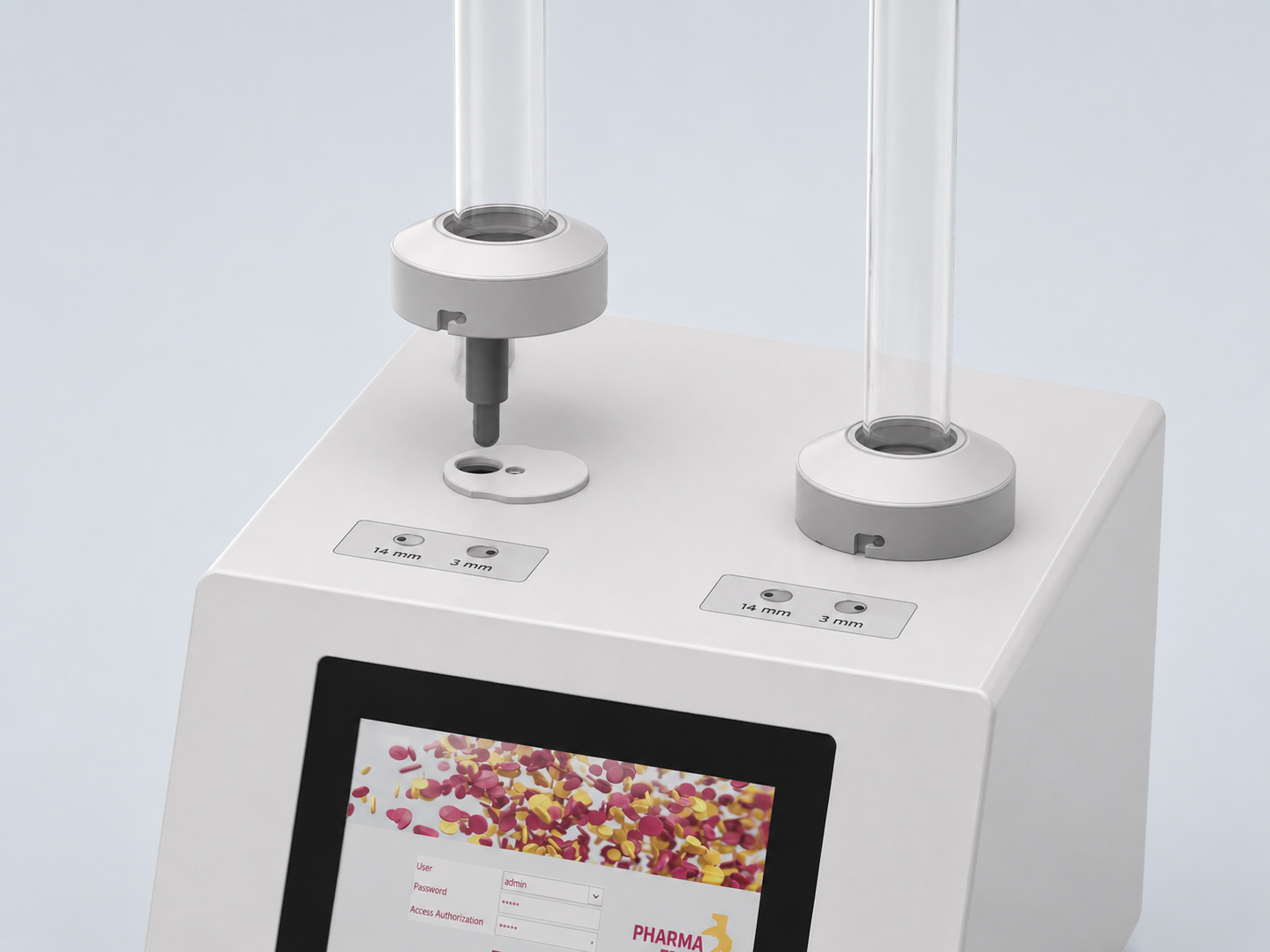
The instrument features two testing stations. The cylinders are held in place by a bayonet catch design.
User Management
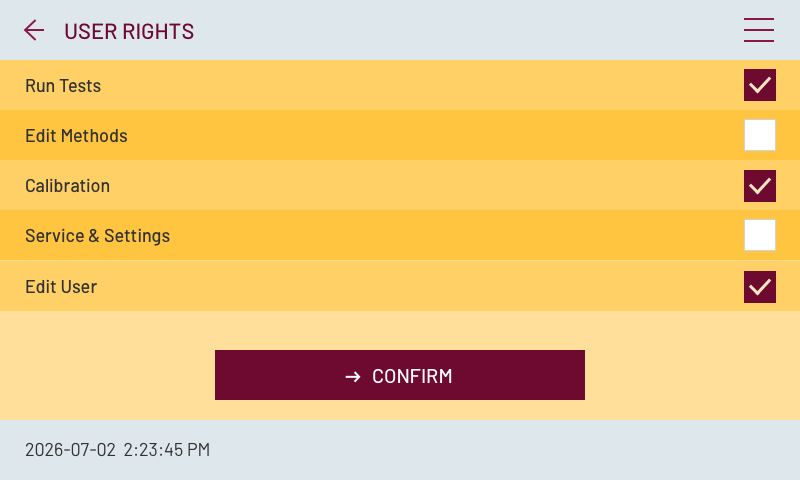
PT-TD430 features a user management system. Users can be defined with username and password and a combination of rights can be assigned to them: run tests, edit methods, perform calibrations, perform service and change settings, edit users.
Quick Test
Optionally the quick test can be accessed without logging in to the instrument first. This way tests can be performed with the instrument in case user access control and testing according to defined methods is not required.
Integrated Report Printer
PT-TD430 features an integrated report printer to document the test and calibration results. An integrated printer saves valuable bench space in your laboratory. The detailed result report includes an automatic weight loss calculation.
Noise Reduction Cabinet
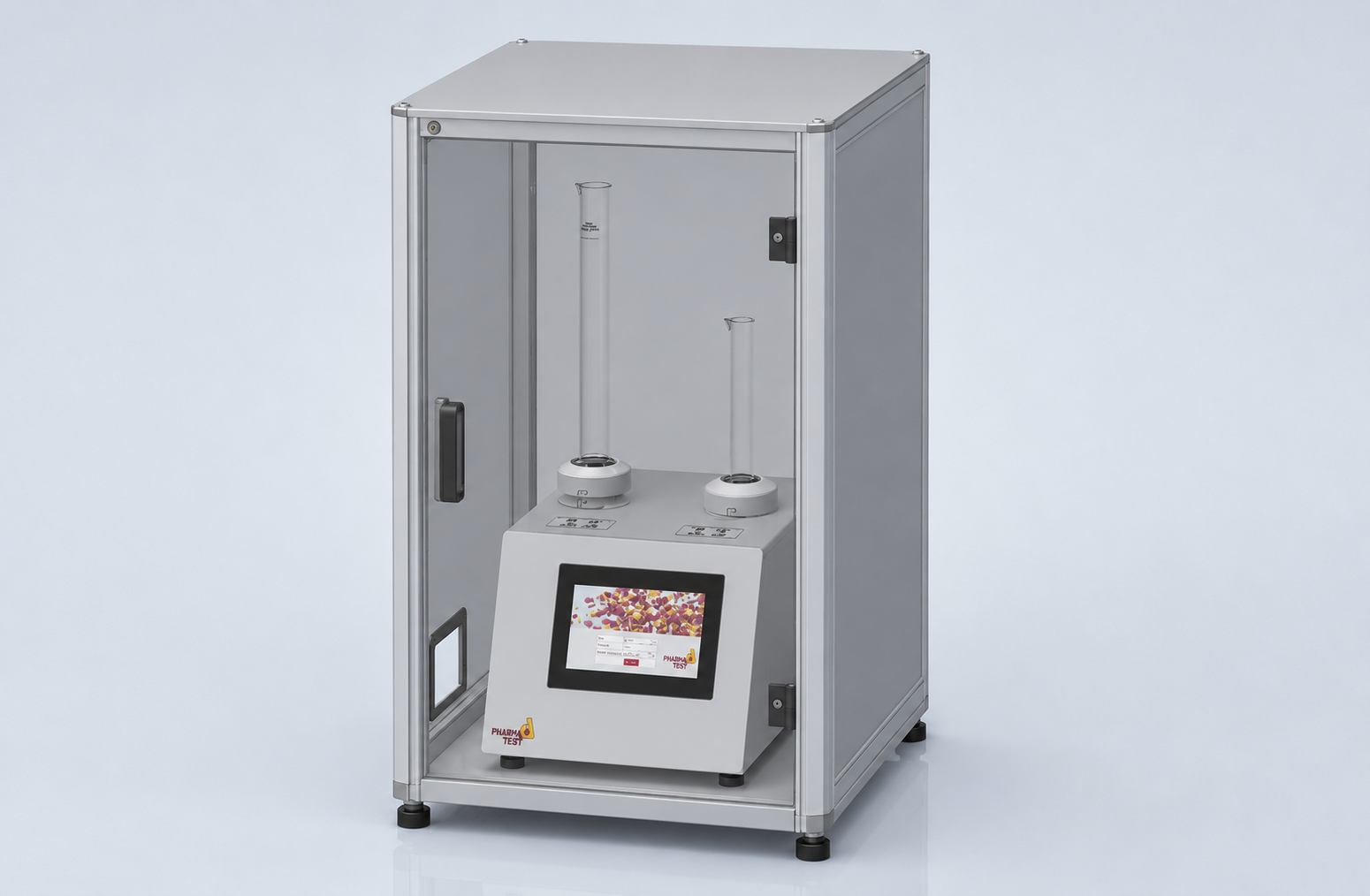
The optional noise reduction cabinet significantly lowers the noise of operation during the tapping process. It features a clear Plexiglass cover that allows the insertion and removal of the test cylinders inside the cabinet. The printer is accessible through a covered opening on the side of the cabinet.
Calibration
PT-TD430 features dedicated calibration programs for tap number, tap height, tap frequency, weight measurement and timer function. The user is guided through each step of the calibration, and a report is printed automatically. A programmable qualification interval timer reminds the user to perform the instrument calibration once it is due. Each time the instrument is turned on it performs a quick self-check to ensure it is ready for operation. The result of the self-check can be documented via the integrated printer as well.
Features
- Fully compliant to USP <616> methods 1 and methods 2 as well as with EP <2.9.34>, DIN EN ISO 787-11 and ASTM B527
- Determine tapped density and apparent density
- User management system
- Method management system
- Entry of time and date
- Connect a balance to determine the sample weight (optional, weight can be entered manually)
- Integrated protocol printer
Advantages
- Test tapped density and apparent density according to both USP <616> method 1 and method 2
- Perform two tests simultaneously
- Automated detection of correct cylinder position according to selected method
- Integrated protocol printer reduces bench space requirements
- Detailed result report incl. calculation of Hausner flowability ratio and Carr compressibility index
- Determine the sample weight to automatically calculate apparent and tapped density
- Quick start to start testing with minimal preparation
- Directly connectable to LIMS or other external systems
- Validation and calibration programs included
- IQ/OQ documents included free of charge
Standard Scope of Supply
At least one cylinder and support set is required to use the instrument:
- 250ml graduated glass cylinder incl. support (492-0250) and/or
- 100ml graduated glass cylinder incl. support (492-0100)
Up to two sets can be used simultaneously. Furthermore, PT-TD430 comes with the following standard scope of supply:
- Comprehensive documentation folder including:
- User manual
- DQ/QC instrument compliance test certificate
- IQ documentation
- OQ documentation
- Instrument logbook
- Compliance certificates for vessels and stirring tools
Options
In addition to the standard scope of supply, Pharma Test offers a broad range of accessories and options including:
- Noise reduction cabinet (492-2100)
- 50ml graduated glass cylinder incl. adapter (part no. 492-0050, requires 492-0250)
- 25ml graduated glass cylinder incl. adapter (part no. 492-0025, requires 492-0250)
- 10ml graduated glass cylinder incl. adapter (part no. 492-0010, requires 492-0250)
Technical Data
| Parameter | Specification |
| Supported test methods | USP <616> method 1 and method 2 (corresponds to requirements from EP <2.9.34> and DIN EN ISO 787-11:1995-10) |
| Number of test stations | Two test stations with two cylinder positions each (one for each method), automated detection of correct position acc. to selected method |
| Stroke height | Method 1: 14.0mm ±2.0mm
Method 2: 3.0mm ±0.1mm |
| Stroke frequency | Method 1: 300 strokes/minute ±5 strokes/minute
Method 2: 250 strokes/minute ±5 strokes/minute |
| Number of strokes | Programmable in three stages from 1 to 9999 each |
| Display | 7” color LCD, backlit |
| Data entry | Touch screen |
| Number of users | Up to 100 |
| Number of methods | Up to 100 |
| Interfaces | 2 x RS-232 serial port to connect a PC or Epson TM-U220B ticket printer, 1 x USB-C port for data export and firmware updates |
| Instrument housing | Powder coated stainless steel housing |
| Power | 100-240 Volt, 50/60 Hz |
| Installation requirements | Ambient Temperature 15-35 °C
Relative Humidity 15-80 %rH Desk with at least 40 kg working load. All around the instrument at least 10 cm free distance to walls or other equipment. |
| Instrument dimensions | Approx. 50cm x 50cm x 45cm (width x depth x height) |
| Packaging dimensions | Approx. 60cm x 60cm x 50cm (width x depth x height) |
| Net /gross weight | Approx. 20 / 25 kg |
| Certification | All components certified to USP / EP requirements |
| CE / EMC Certification | All CE / EMC Certification provided |
| Validation | All IQ & OQ documents included |